




Espiocracy Release Date: Why the Spy Game Moved to 2027

Espiocracy has been one of the most intriguing names on Hooded Horse's strategy slate since its Steam page went live: a grand strategy game where you never command an army, only an intelligence agency. Anyone who wishlisted it now has a firm answer to the obvious question. In its August 2026 dev diary, Ex Vivo Studios moved the tentative release date to the third quarter of 2027.
The studio was frank about the reason. The core game is already satisfying, it said, but stability, quality, content, the learning curve and the interface still need work. Rather than rush, the team plans to widen its playtests and release a demo, then act on the feedback from both before launch.
That honesty fits a project that has been developed in public for years, with a dev diary appearing roughly every month. Those diaries reveal a remarkably deep simulation: 74 playable countries, 34 types of operations, autonomous operatives with their own biases, and a world that reacts when you back a faction or arm a guerrilla movement.
Below, we break down what the new Espiocracy release window means, how the game actually plays, which systems the latest diaries confirmed, and whether this is the Cold War strategy game you have been waiting for.
Release date: Tentatively Q3 2027 (no exact date)
Developer: Ex Vivo Studios
Publisher: Hooded Horse
Genre: Espionage grand strategy
Platforms: PC (Steam)
Official website: espiocracy.com
Why Espiocracy moved to Q3 2027
A delay announced more than a year ahead is rarely bad news for a strategy game. Grand strategy lives or dies on the hundreds of hours players sink into it, and a release that is unstable or impenetrable tends to be judged harshly. Ex Vivo Studios is a small team led by designer Rafał Grochala that has been building the game since early 2021, so the extra time is significant – but it comes with concrete promises: broader playtests and a public demo before launch.
Note the word "tentative". Q3 2027 is a target, not a locked date, and the studio has not named a day or month.
Running a spy agency instead of a nation
You pick one of 74 countries and take charge of its intelligence agency from the start of the Cold War. You do not run the government directly, but your operations shape what it does and what happens to its rivals. Even if your nation loses a war, suffers a coup or changes leadership because of foreign meddling, the agency carries on through the twists of the twentieth century.
The tools are what make Espiocracy distinct: propaganda, support for political factions, independence movements, proxy wars, assassinations and coups. Players who enjoyed managing a planned economy in Workers & Resources: Soviet Republic will recognise the Eastern Bloc setting, but here the focus moves from factories to informants.
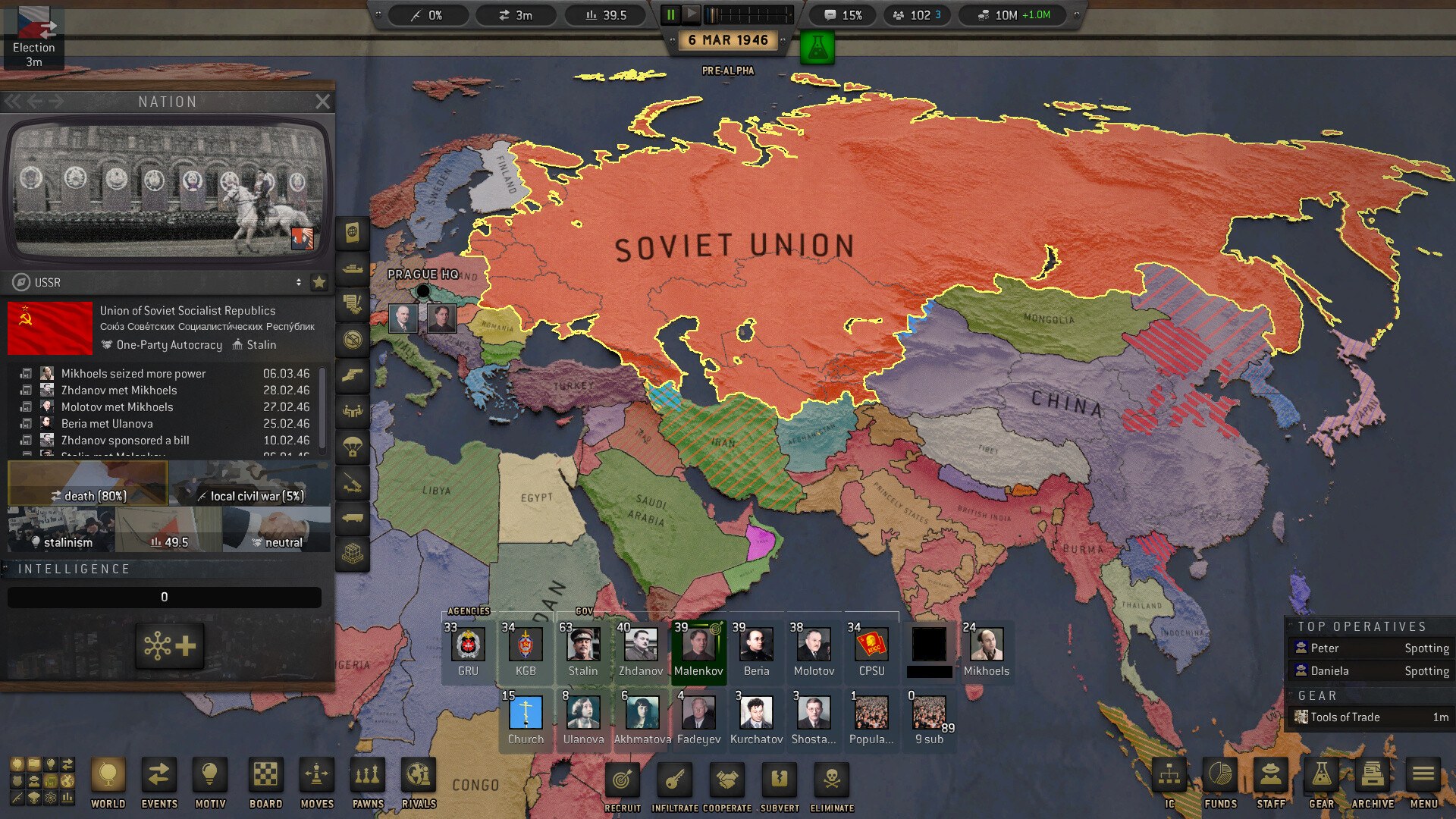
March 1946: the Nation panel tracks the USSR while a row of influential Soviet actors – including Stalin, Beria and Molotov – waits to be watched, recruited or manipulated.
Actors, operatives and 34 kinds of operations
Rather than abstract sliders, the game populates the world with "actors": historically accurate individuals, parties, trade unions, guerrilla forces and whole sectors such as the military or the media. Each has its own agenda, competence and resources, and many of them move between countries.
Your own people are just as human. Operatives act with relative autonomy, shaped by their traits and histories. Some will open unique opportunities; others may struggle with their assignments or be turned by a foreign power. Officers can even form political subgroups inside your agency, and when they retire they can become actors you no longer control.
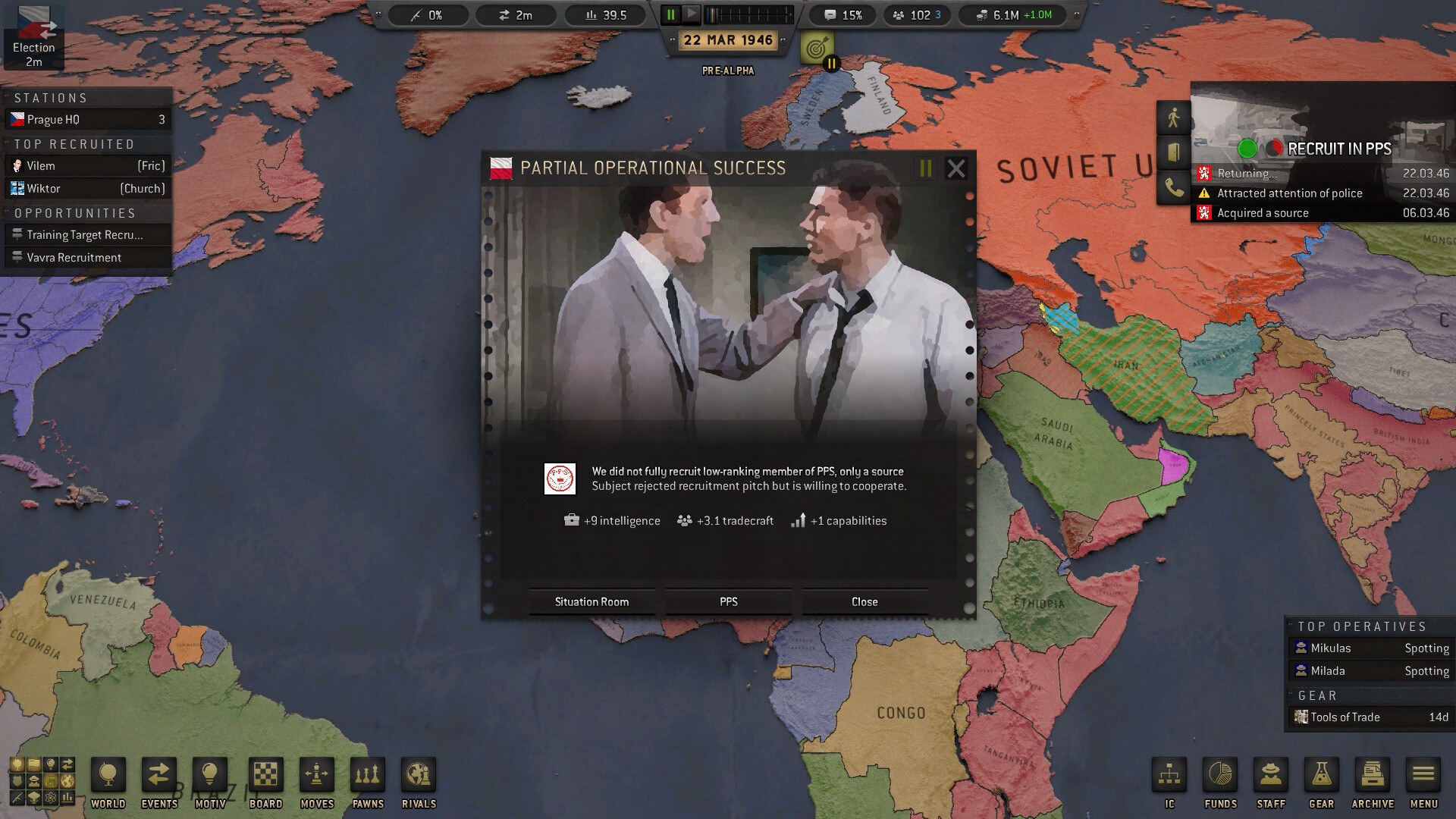
Not every pitch lands: this report shows a recruitment attempt that produced only a source instead of a full agent, with the gains in intelligence and tradecraft listed below.
What the 2026 dev diaries added
This year's diaries filled in several key systems. One compared how the USA and the USSR play, false intelligence became part of the game, and moddable "points of divergence" now let history branch at plausible moments. A SIGINT diary introduced signal-interception sites that can be built in friendly countries, so where you place your listening posts matters.
October's diary tackled the steep learning curve with periodic situation reports, deputy memos recommending actions, and "The Book", a regular summary of world events.
Strengths and open questions
Few strategy games treat espionage with this level of detail, and the transparent development is reassuring. The open question is accessibility: Espiocracy combines the complexity of the Cold War with the complexity of spycraft, and the planned demo will be the first real test of whether newcomers can find their footing.
Who should keep an eye on Espiocracy
If you like strategy built on information, influence and long-term consequences rather than battlefield conquest, Espiocracy belongs on your wishlist – just plan on waiting until at least Q3 2027. Until then, a turn-based classic such as Sid Meier's Civilization V is an affordable way to keep scratching that grand strategy itch.