




Modern Warfare 4 Hits Switch 2 on October 23

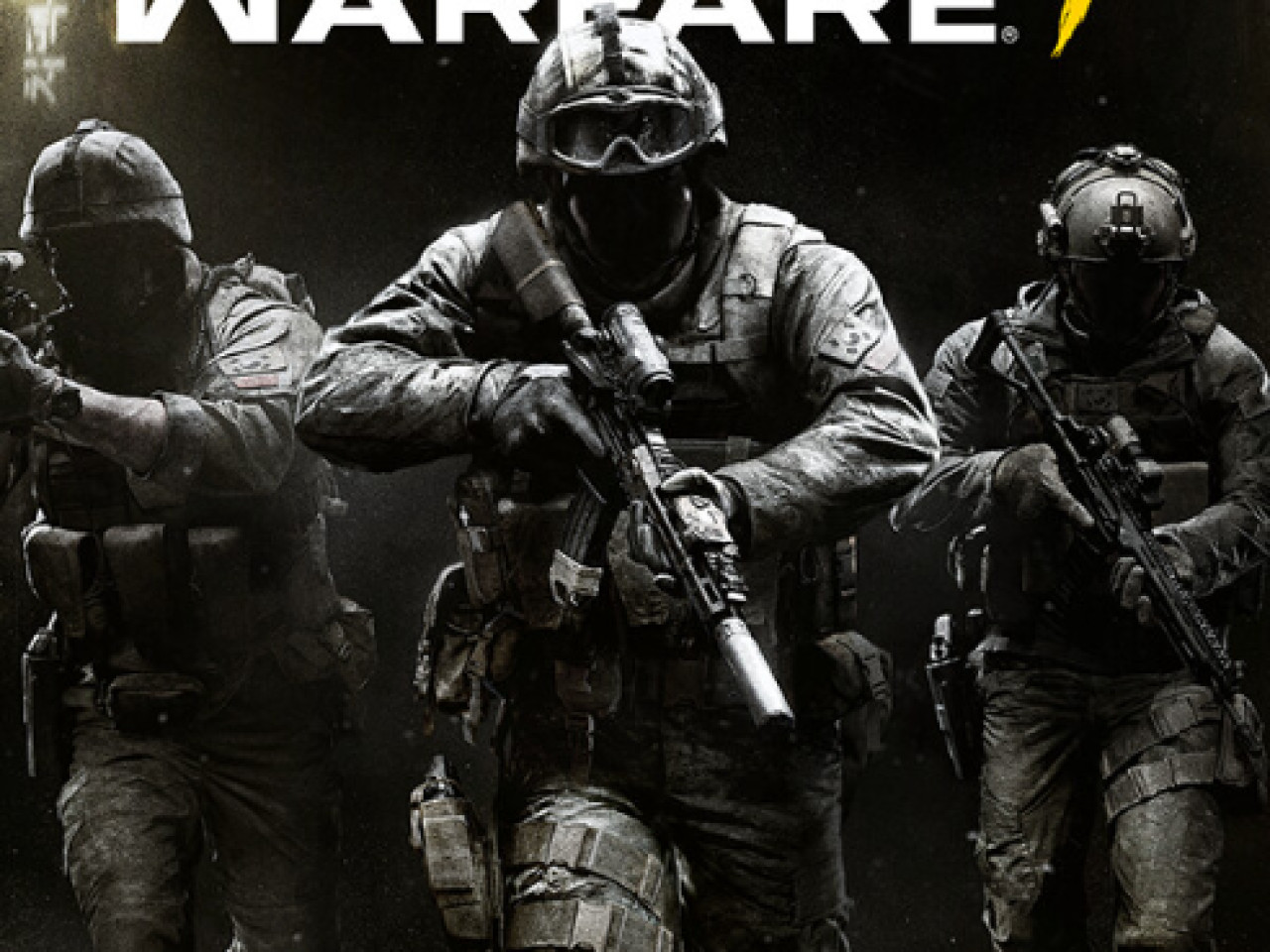
The question most players type first is not “is it a Call of Duty.” It is “when, and on what.” Infinity Ward and Activision have answered in the open: Call of Duty: Modern Warfare 4 launches worldwide on Friday, 23 October 2026 for PlayStation 5, Xbox Series X|S, PC, and Nintendo Switch 2. Last-gen hardware is out. Digital pre-orders already exist on Xbox, PlayStation 5, Battle.net, Steam, and Xbox on PC; Switch 2 pre-orders opened later in the summer. Digital pre-orders also unlock campaign early access from 16 October — a week of single-player before the multiplayer floodgates open.
That date sits inside a larger shift. Call of Duty: Modern Warfare 4 is the first Modern Warfare in more than a decade to ship natively on Nintendo, with Digital Legends building the Switch 2 version alongside Infinity Ward. It is current-gen only: no PlayStation 4, no Xbox One, and Warzone on those platforms winds down as Season 1 arrives. The campaign pitch is a Korean Peninsula invasion colliding with a vengeful Captain Price; multiplayer is sold on “Ballistic Authority” gunplay with bloom removed; DMZ returns as a full extraction mode. This article sticks to what Activision has put on the record — street date, platforms, campaign shape, and the systems that change how a match feels — so you can decide whether October is a must-buy or a wait-and-see.
Release date: 23 October 2026
Developer: Infinity Ward
Publisher: Activision
Genre: First-person shooter
Platforms: PlayStation 5, Xbox Series X|S, PC (Battle.net, Steam, Xbox on PC), Nintendo Switch 2
Official website: callofduty.com
A Korean front, and Price off the books
The campaign of Call of Duty: Modern Warfare 4 splits its attention on purpose. You fight as Private Park, a South Korean soldier whose routine patrol becomes a full-scale North Korean invasion — trench fighting at home, then the war’s spread into New York close-quarters, Paris vehicle chases, SAS night raids in Mumbai, and city assaults to take territory back. Infinity Ward is leaning on military and cultural detail for a setting the series has not used as a main theatre. Parallel to that, Captain Price is no longer the sanctioned Task Force 141 lead; he is an operator-turned-outlaw chasing revenge and a weapon that could tilt the war, pulling him into alliances he cannot walk away from.
That dual structure is why the reboot trilogy’s unfinished business actually matters here. Price’s arc has been the through-line since 2019; Park is the ground-level cost of a war the old cast helped set in motion. Whether the campaign can hold both emotional registers — squad desperation and spy-novel consequence — is the open question. What is confirmed is variety of set pieces rather than a single corridor of raids. If you want the last numbered chapter of this continuity before October, Call of Duty: Modern Warfare II is still the catalog title that rebuilt the gunfeel and the Task Force roster this sequel is now straining.
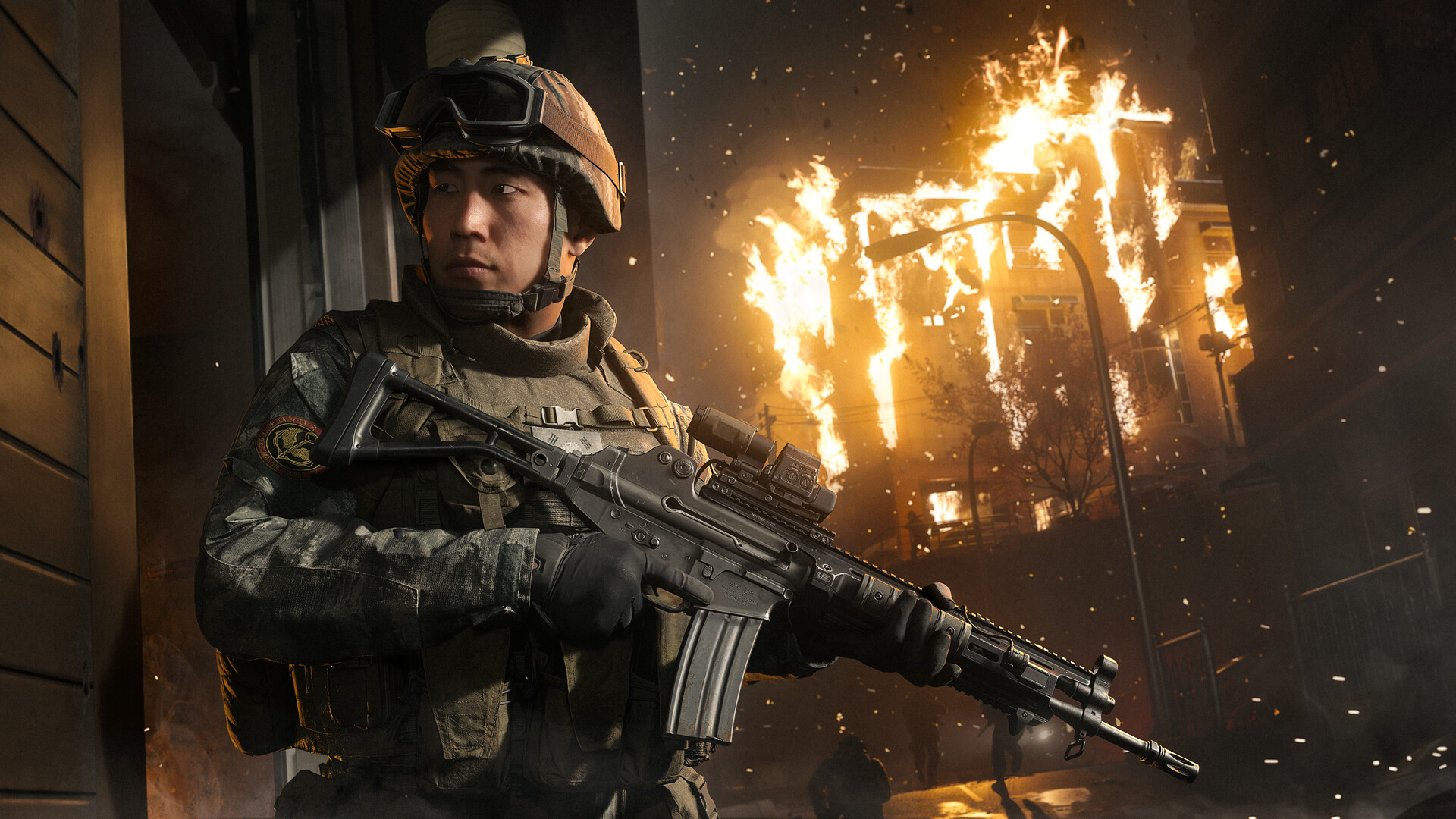
Campaign still from Call of Duty: Modern Warfare 4: a South Korean soldier in the street as a building goes up behind him — the invasion Infinity Ward is using as the war’s spark.
Bloom is gone. Switch 2 is in.
Multiplayer is being framed around control, not spectacle. Ballistic Authority is Infinity Ward’s name for a stack that ties bullet path, weapon motion, stance, camera, audio, and visibility together, with bloom removed so hipfire points where the muzzle points. Mantling, climbing, hanging, and jumping are expanded so vertical routes are part of the fight rather than a parkour extra. Twelve core maps ship with custom infils; Kill Block is a modular training-facility playlist that reconfigures between rounds from more than 500 layouts. Gunfight, large “Big War” vehicle maps, shared-class Gunsmith attachments, Apex Attachments on fully ranked guns, and a split Prestige path (classic reset versus keep-your-loadouts) round out the systems list. DMZ is back as a living exclusion zone: recover military tech, ride shifting weather and AI, extract or lose the bag.
The platform story is as important as the playlist. Call of Duty: Modern Warfare 4 will not launch on last-gen consoles. Nintendo Switch 2 is a native build, not a stream. PC gets Beenox’s tuning pass — upscalers, frame generation, DLSS 4.5, and ray-traced reflections, ambient occlusion, shadows, and volumetrics across campaign, multiplayer, and DMZ. Beta PC minimums published in August are a useful floor (Windows 10, six-core-era CPUs, 12 GB RAM, an SSD), but those numbers are labelled for the beta, not as a locked launch card. One commercial wrinkle worth knowing: unlike recent Black Ops releases, this Modern Warfare is not planned for Xbox Game Pass on day one.
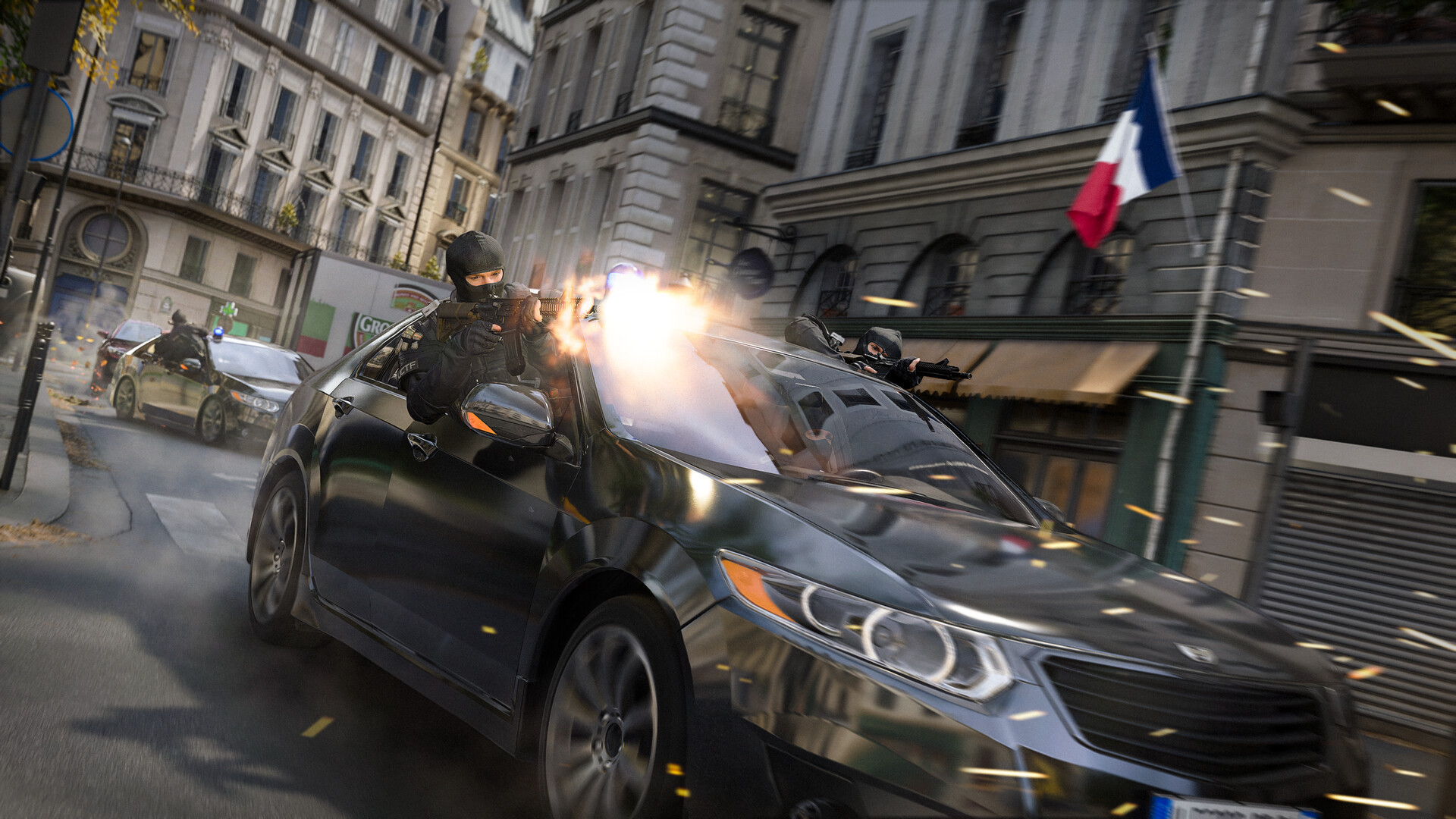
The Paris chase Infinity Ward called out in the campaign brief — operators leaning from cars on a flagged street, the kind of set piece that sits between Korea’s trenches and Price’s off-book hunt.
Who this October is for
Call of Duty: Modern Warfare 4 is for players who still want a boots-on-ground gunfight with a dated street date, a campaign that names its maps, and a Nintendo SKU that is actually being built rather than promised. It is a weaker fit if you live on Game Pass day-one drops, if you are still on PS4 or Xbox One, or if annual CoD fatigue is already the deciding vote. Concerns that belong in the same paragraph as the hype: an October launch after a public beta is a short polish window; extraction DMZ lives or dies on whether the zone stays interesting after week two; Switch 2 performance is still an unproven native target for this series.
If you want the immediate predecessor’s multiplayer and campaign while you wait, Call of Duty: Modern Warfare III is the last numbered entry you can finish tonight — same universe, already patched, no October calendar attached. When the 23 October keys go live, Urazon is a straightforward place to compare PC prices without the storefront noise. Until then, the facts are unusually firm for this franchise: one Friday, four platforms, no last gen, and a Korean war that finally has a clock on it.