




Is Senua Hellblade 3? What Ninja Theory Confirmed

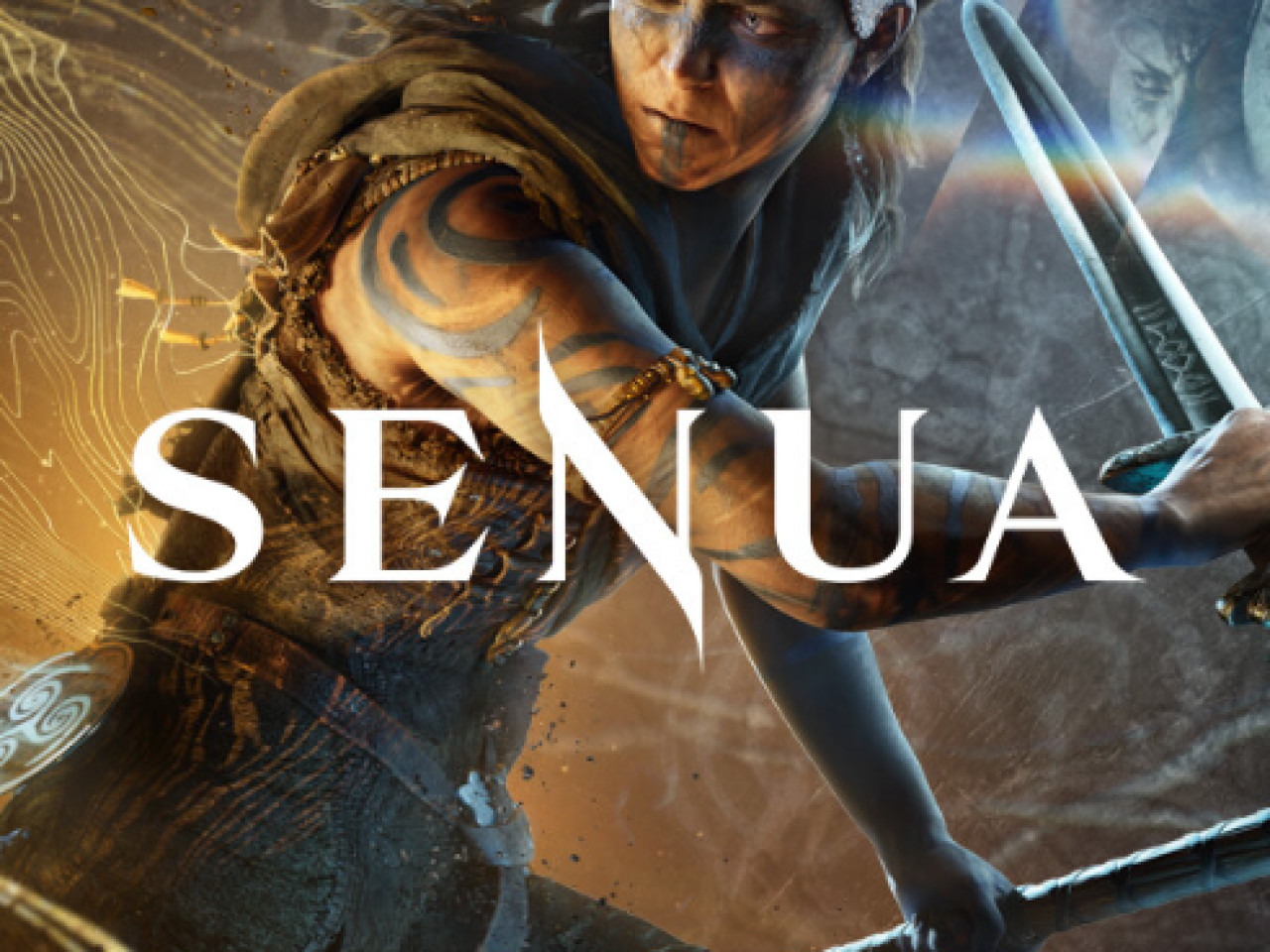
Call it Hellblade 3 in a search box and you will get arguments in the replies. Ninja Theory does not. The studio spent the Xbox Games Showcase in June 2026 insisting that Senua is a new kind of project: a premium action-adventure with the same heroine, the same psychosis-informed audio, and a much wider brief for combat, traversal, and puzzles. It follows Senua’s Saga: Hellblade II in the timeline — purgatory after both previous games — but studio head Dom Matthews has been explicit that the name drop is the point. A different intention needs a different title.
That distinction is the actual news cycle around Senua right now, more than any day-and-date rumor. Xbox Game Studios is still listed as publisher. Platforms on the record are Xbox Series X|S, Windows via Xbox Play Anywhere and Steam, cloud play, day-one Game Pass, and PlayStation 5. The window is 2027, not a locked month. Official language talks about dual-wielding, stealth as a valid opener, Focus abilities that rewrite spaces, and a single interconnected map roughly twice Hellblade II’s footprint without becoming an open-world checklist. This article gathers what Ninja Theory and Xbox have actually said about Senua — naming, systems, story framing, and who it is for — and leaves forum speculation about studio ownership out of the facts box.
Release date: 2027
Developer: Ninja Theory
Publisher: Xbox Game Studios
Genre: Action-adventure
Platforms: Xbox Series X|S, PC (Microsoft Store, Steam), PlayStation 5
Engine: Unreal Engine 5
Official website: xbox.com/games/senua
A standalone door into purgatory
Story-wise, Senua is trapped between life and death inside a vision of her childhood homeland. Healing the wounds of her life is the key she believes will open the afterlife and reunite her with people she has lost. Returning players will catch familiar faces and themes; Ninja Theory’s stated ambition is that newcomers still understand the plot without a wiki tab. The gold motif in the trailer is described as a beautiful, eroding force that threatens what she believes — and what she might become — without a full lore dump attached.
That is a bigger emotional canvas than a linear corridor of boss trials, which is why comparisons keep drifting toward other mythic action-adventures you can finish now. God of War Ragnarök already pairs intimate character work with readable melee and a map that invites lingering; it is not a Hellblade clone, but it is the closest “play this while 2027 approaches” recommendation if you want authored Norse-adjacent drama with real combat weight.
Tactical fights, not a spectacle reel
Matthews’ useful phrase is “tactical choice.” Senua can sneak a camp, throw a scavenged axe at a high perch, dual-wield almost anything she can holster, or crash in with a torch she ripped off an enemy. Multiple opponents, vertical arenas, and environmental tools are the expansion over the previous games’ heavier, more authored duels. Focus abilities — beliefs that let her shatter or rewrite reality — are meant to work in traversal, puzzles, and crowd control, not as a cutscene super move. Boss fights are promised at a scale the Hellblade pair only hinted at.
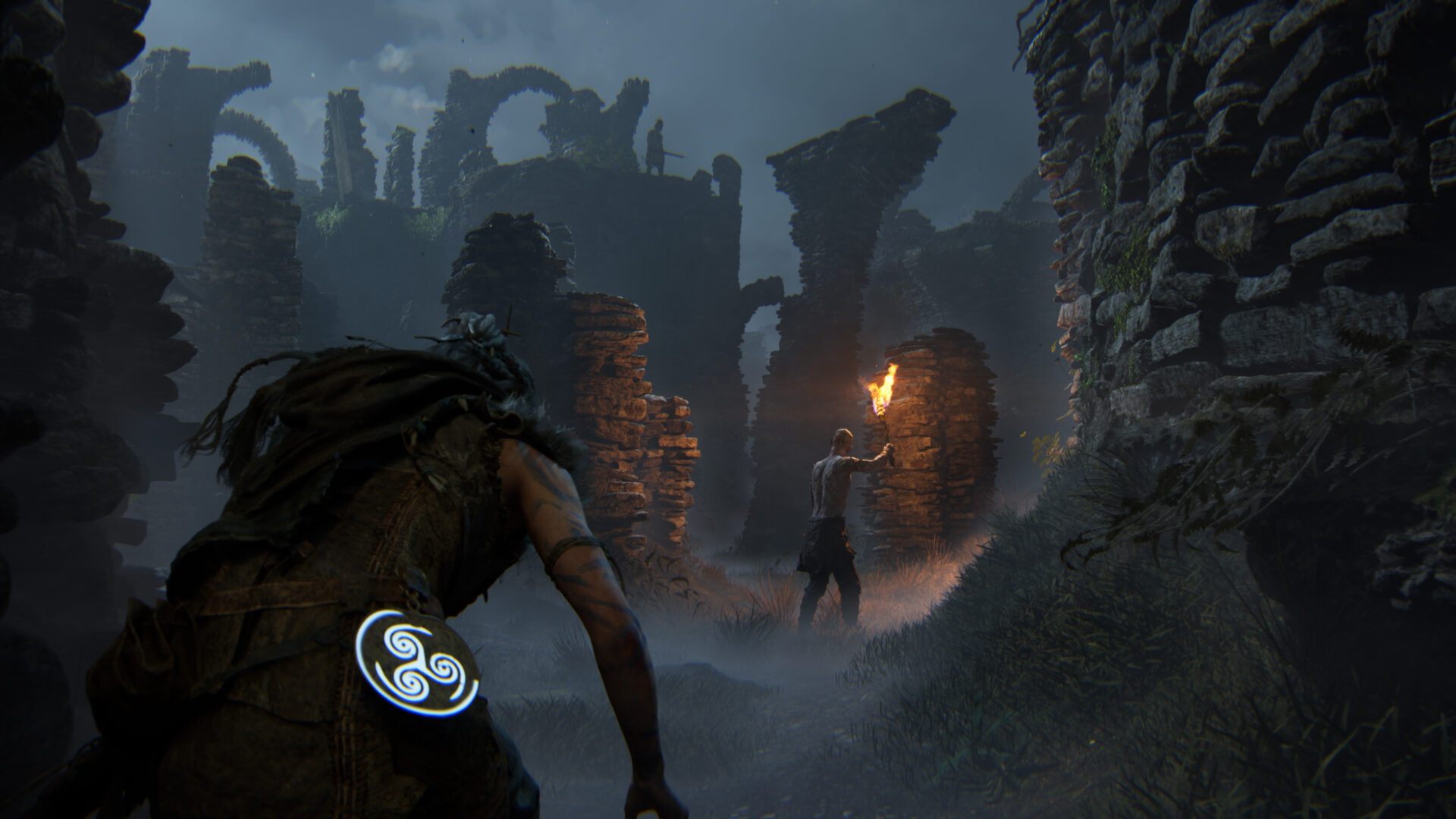
Stealth is a first-class option in Senua — Ninja Theory showed her stalking torch-lit ruins instead of forcing every encounter into a duel.
The split they are designing toward is roughly even between combat, traversal, and puzzle-solving, not a character-action game with a story wrapper. Vaulting, climbing, and faster movement are called out as a deliberate break from Hellblade’s slower gait. Whether that mix stays balanced over a full campaign is the open question; the trailer cannot answer it. What is confirmed is agency: you can skip a fight, route around it, or use the space as a toybox.
One map, linear story, more room to look
Ninja Theory is not selling an open world. The map is a single interconnected space, about twice Hellblade II, with a linear story that still lets you return to earlier locations and get paid for paying attention. Matthews’ example is almost a design manifesto: a tree that looks like scenery until a later belief turns it into a key. Perception is the exploration reward, which fits a game still told through the lens of psychosis and still built with input from mental-health collaborators.
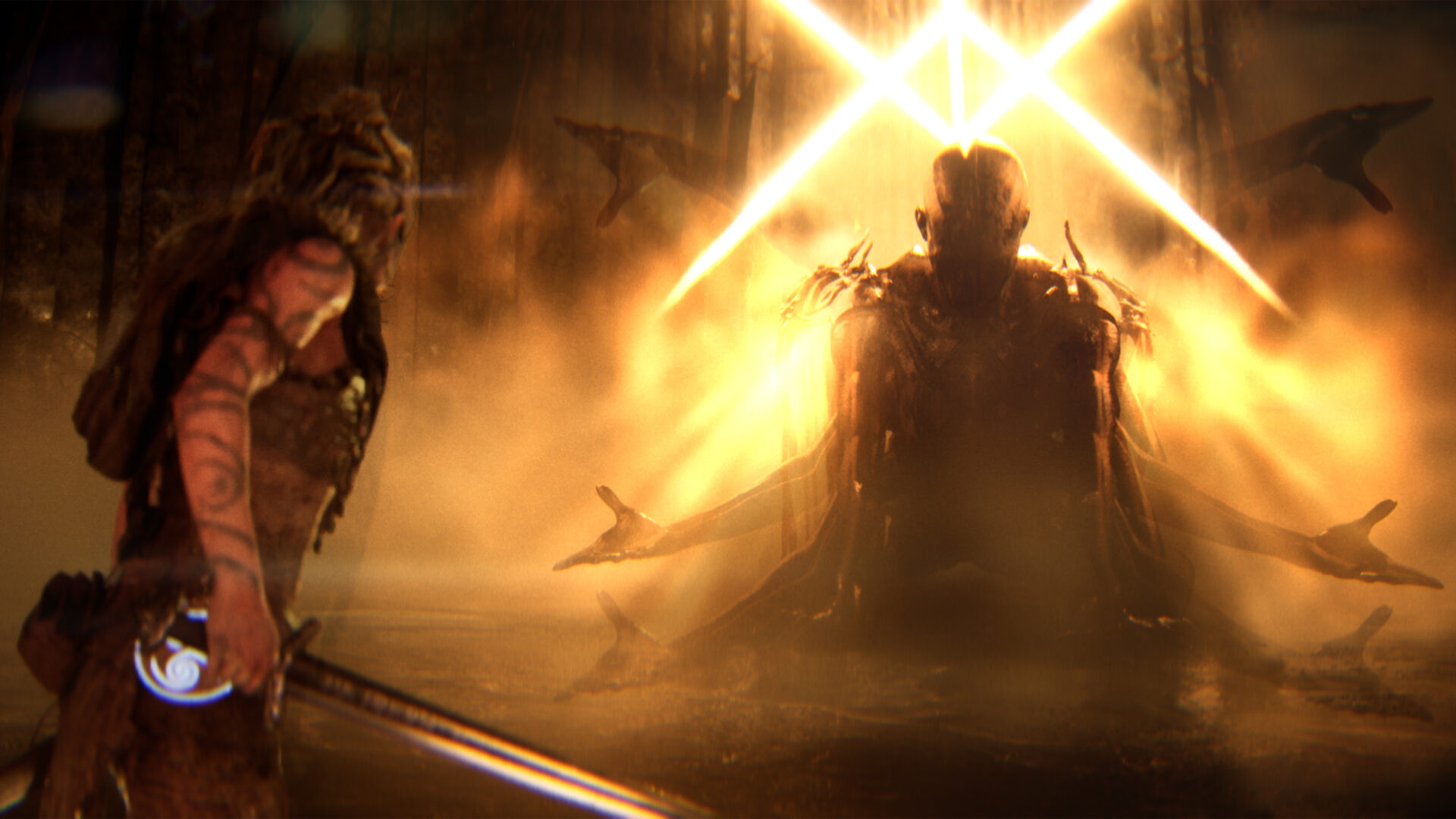
Fantastical boss encounters are part of the pitch for Senua — a multi-armed figure under a golden flare, closer to mythic set pieces than the last two games’ grounded brawls.
Senua is for two audiences at once: Hellblade loyalists who wanted more systems, and action-adventure players who bounced off the previous games for being too much film, not enough toy. Concerns worth keeping honest: 2027 is a year, not a date; expanding combat can dilute the intimacy that made the series famous; and a studio of about 85 people is still small for a three-platform “premium” brief. If you want a meditative journey with less swordplay while you wait, Death Stranding Director's Cut remains the odd, beautiful option — walking as gameplay, connection as theme — a very different fantasy than Celtic purgatory, but the same patience for atmosphere. Senua is the 2027 watch if you want Ninja Theory swinging back toward Enslaved-and-Heavenly-Sword craft without dropping the voices in Senua’s head.